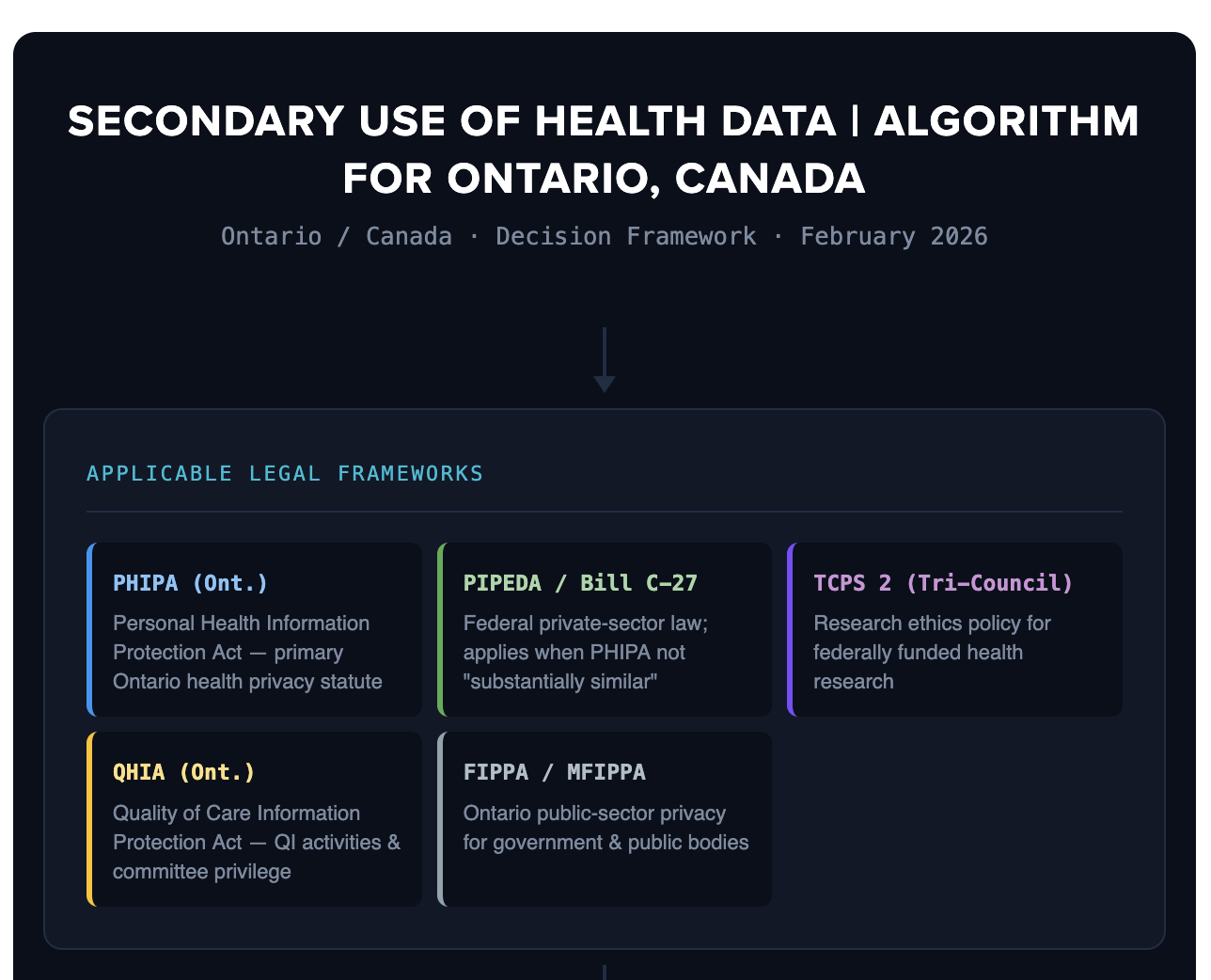
Navigating laws relevant to secondary use of health data in Canada can be extremely difficult. I’ve created a decision aid that engages relevant frameworks for Ontario. This tool is currently under development and should not be taken as a substitute for legal advice. As always, legal acceptability should not be taken to equate to social license or normative desirability.
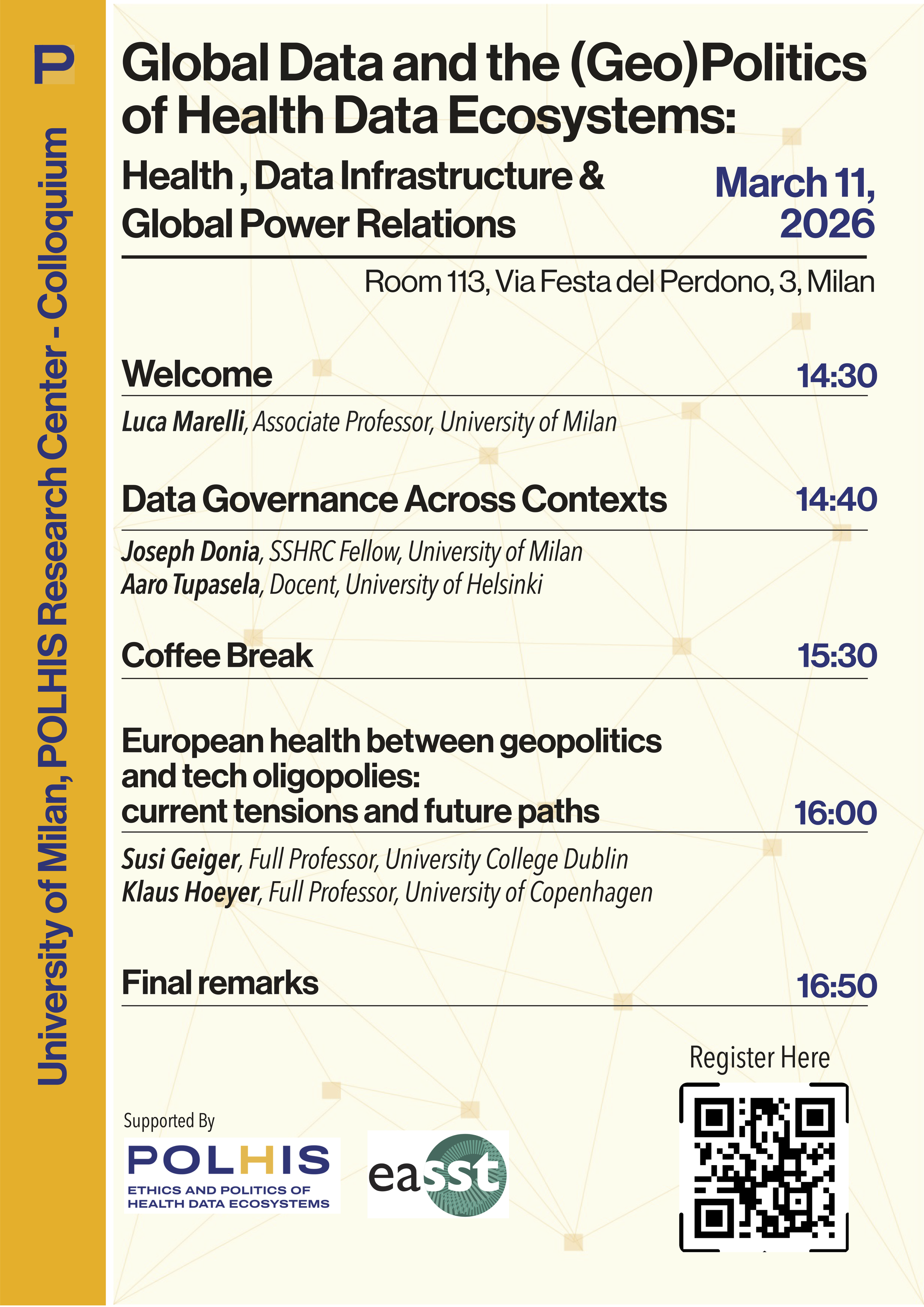
Health Data Spaces in a Global Context: Colloqium in Milan, Italy
This March, the EHDS Forum will be organizing its second meeting and a public colloquium in Milan, Italy, 10-11 March 2026 supported by the EASST Fund.
Newly established health data ecosystems such as the European Health Data Space (EHDS), alongside comparable developments in other global contexts, are increasingly central to contemporary health and innovation policy. While often framed as technical and regulatory infrastructures, these initiatives also constitute full-fledged political projects that reshape relations between citizens, public institutions, and commercial actors.
This colloquium foregrounds key STS and policy themes raised by health data spaces, including questions of social license, public accountability, democratic legitimacy, and public value. It further situates these developments within broader (geo)political dynamics concerning data sovereignty, strategic autonomy, and global power asymmetries. By adopting a comparative and conceptual lens, this colloquium invites critical reflection on the governance, imaginaries, and broader socio-political dynamics underpinning emerging health data ecosystems.
Credit: Benedetta Muda
What is the European Health Data Space?
Canadians often ask me about the European Health Data Space (EHDS), so I thought I would put together a brief primer on the regulation. For more information or additional resources please feel free to get in touch.
STS Italia 2025
STA Italia’s 10th Annual Conference “Technoscience for Good: Designing, Caring and Reconfiguring” will be held June 11 - 13 2025 at at Politecnico di Milano. Consider submitting to our open panel Designing Worlds, Worlding Design: The Ethics and Politics of Value Creation in Digital Health and Health Data Integration.
4S / EASST Joint Conference in Amsterdam
This July the quadrennial joint meeting of the European Association for the Study of Science and Technology (EASST) and the Society for Social Studies of Science (4S) will take place in Amsterdam. I will be presenting Making data markets: the value of assetization and the assetization of values in a digital health start-up.
Data Justice Conference 2023
I’ll be at the 2023 Data Justice Conference in Cardiff, Wales, where I will present “Institutional Ethnography & Data Justice: Concepts, Tensions, Practical Applications”
AIES 2021: Co-design and Ethical Artificial Intelligence for Health – Myths and Misconceptions
I’m presenting Co-design and Ethical Artificial Intelligence for Health: Myths and Misconceptions at AIES 2021.
Richard Whitby's The Lost Ones at SALT
This month I had the chance to visit Salt Galata, a contemporary art space occupying a former bank building in the Karaköy district of Istanbul. This work by Richard Whitby titled The Lost Ones was on, showing residency status assessments being carried out by an unforgiving, disembodied voice.
Through dark humour, it highlights the casual violence of bureaucratic processes that increasingly reduce complex lived realities data points and scores, and abstractions of eligibility, compliance, and risk, making visible how technical processes of classification are bound up with questions of belonging and exclusion, highlighting the politics of datafication and its impact on everyday life.
Moving Patient Engagement to the Centre of Health Care
To improve the health care system, we need to think bigger about the role of patient engagement. Engagement must be embedded in daily practice.
I wrote this op-ed for the Institute for Research on Public Policy's July issue of Policy Options.
How Librarians are Rising to Their Next Challenge: The Opioid Crisis
Libraries are among our most accessible public spaces. In this Toronto Star article, a strategic partnership between Toronto Public Library and Toronto Public Health highlights how moving care into the community improves access to critical services.